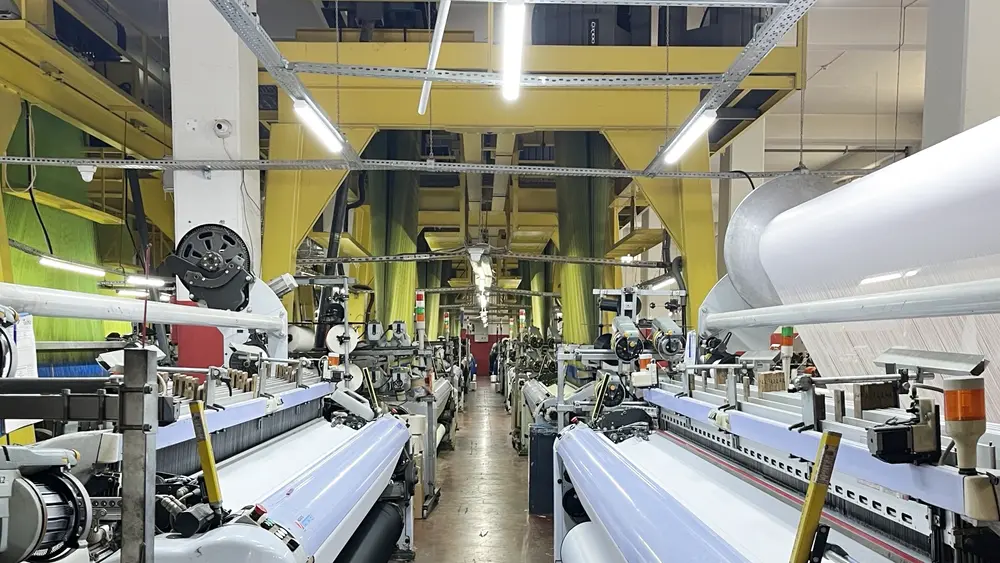
Weaving is two sets of threads crossing at right angles: a weft thread passes across the warp threads that run along the fabric. The pattern depends on which warp threads lift for every pick. A jacquard head makes that choice for each thread on its own.
Hooks, cords and heddles
The jacquard head sits above the loom. Inside it, upright hooks stand in rows. From each hook a cord runs down, through a board with holes, to a heddle. Every warp thread passes through the eye of one heddle, and weights below the heddles keep the threads down.
For every pick, knives between the hooks rise. The chosen hooks catch on the knives and rise with them, while the others stay where they are. So each warp thread goes up when its own hook is chosen.
The drawing has 16 threads and 16 hooks. A real jacquard head has thousands of hooks, so every thread across the width of the cloth can be controlled on its own.
What happens in one pick
- The shed opens: the jacquard lifts the hooks chosen for this pick. Their threads go up and the rest stay down. The gap between them is called the shed.
- The weft goes in: the shuttle travels across the shed and back, leaving the weft thread in the shed.
- The reed beats: the reed swings forward and packs the new pick against the edge of the cloth.
- The shed closes: the threads return and the jacquard chooses the hooks for the next pick.
Press "Start the loom" and it begins to weave. The buttons below it pause, speed up or slow down the loom, and the arrow keys move it one pick at a time. In front, a tulip grows in the cloth row by row.
From punched cards to electronics
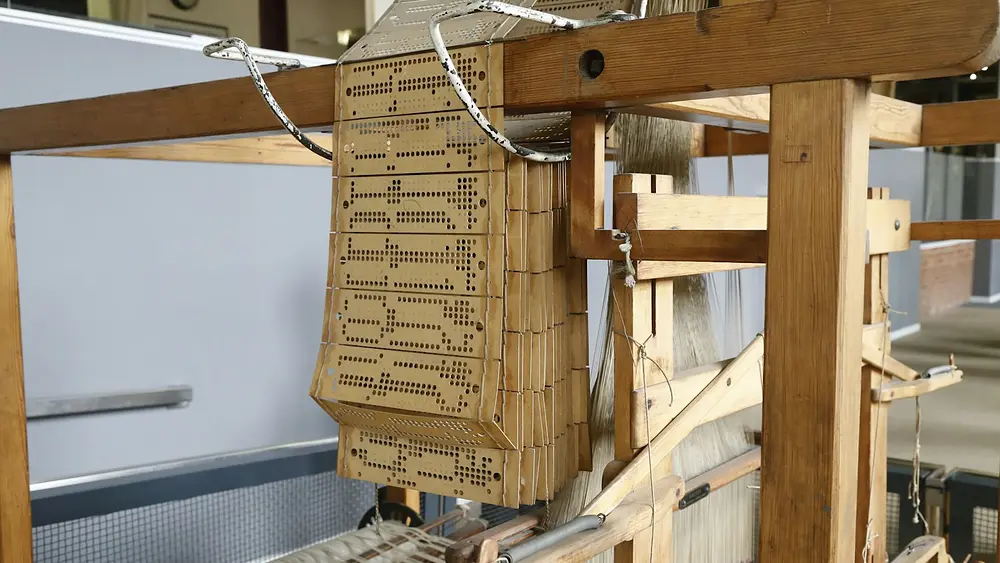
The machine is named after Joseph Marie Jacquard, who developed it in 1804. On the first jacquards the choice was made by punched cards: where the card had a hole the hook lifted, and where it had none the hook stayed. Every pick needed a card, and a large pattern could take thousands of them. Today electronic jacquards make the same choice, and the pattern file goes straight from the computer to the machine.
What a jacquard weaves
Because every thread is chosen on its own, the patterns are almost unlimited: florals, medallions, logos and large motifs. Of our fabrics, TK-T04 is a jacquard weave, and our sheer collection includes jacquard sheers.
Small, geometric patterns only need a dobby, which lifts the threads shaft by shaft. Read how a dobby loom works, or see both side by side in jacquard or dobby.