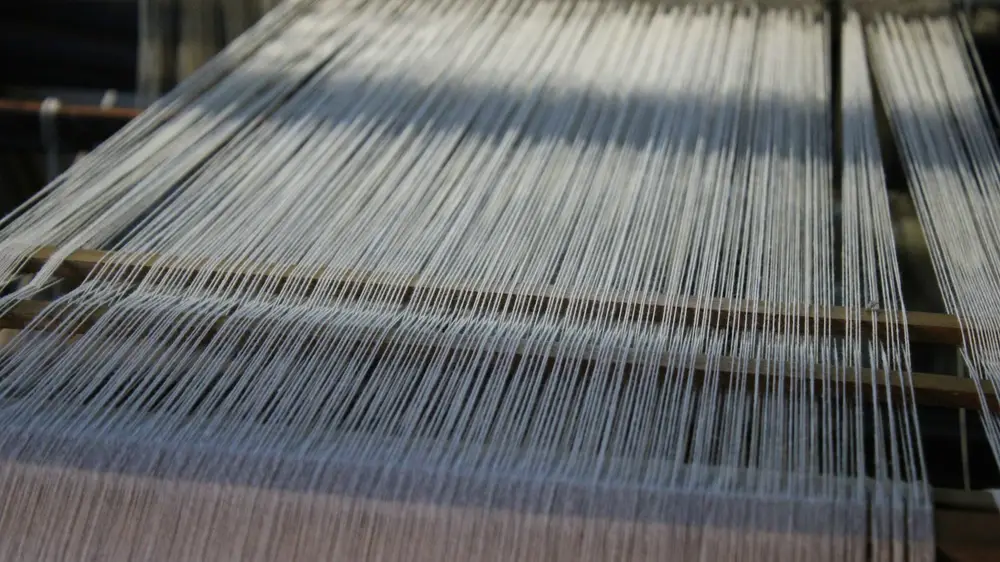
All the threads that run the length of a fabric, the warp, are prepared before weaving starts. Hundreds, often thousands, of threads must be wound side by side onto one beam, all the same length, at the same tension and in the right order. That beam goes on the loom and is the base of the fabric.
One of the machines that does this is the sectional warping machine. The drawing below shows how it works.
How a sectional warper works
- Creel: yarn cones are set on the large rack at the back, the creel. One warp thread comes off each cone.
- Tension: each thread runs through a pair of tension discs, which keep every thread at the same tension.
- Comb: the threads pass through a comb that puts them in order and gathers them to the width of one section. The comb sits on a carriage that slides along a rail.
- Drum: the gathered threads are wound onto the big drum. A cone at one end of the drum keeps the first section from slipping sideways.
- Next section: when a section reaches the length needed, the comb slides along and the next section is wound beside it. When all sections lie side by side, the whole warp is on the drum.
- Beaming off: finally all the sections are unwound together from the drum onto the beam that goes on the loom.
Press "Start the machine" and the warper starts. The buttons below it pause, speed up or slow it down, and the arrow keys move it one turn at a time. The drawing has 18 cones and 6 sections; a real creel holds hundreds of cones.
Why section by section?
Winding the whole warp at once needs as many cones on the creel as there are threads in the warp. In sectional warping the creel only carries the threads of one section, and the same cones wind one section after another. That way even striped, multi-coloured warps can be prepared section by section without losing their order.
Fabric quality starts here
If one warp thread is looser or tighter than the rest, it causes trouble in weaving. That is why warping is one of the most important steps before weaving. As we say on our Services page, the quality of the fabric takes shape at this stage.
Once the warp is ready, the beam goes on the loom and weaving begins. How the loom lifts the warp threads is explained in how a jacquard loom works and how a dobby loom works.